The road test driving route should not be learned or memorized but rather understood as a practical example of the choices you will have to make in real situations, under stress, on the day of your exam. Well, the best road test practice routes are definitely not hidden ones; rather, they're driving routes that allow you to practice the right driving techniques, such as controlled turns, lane changes, busy intersections, and parking, until you do them consistently and not just by luck. Jim's Insync Driving School is all about this concept of road test preparation.
What Makes a Practice Route Genuinely Useful?
The practice route must be varied as well. Driving on the same peaceful street over and over again could help the novice driver with the basics of steering and braking; however, it will not give the driver experience with the kinds of driving scenarios encountered on a road test.
What Should a Beginner-Level Road Test Route Include?
For a beginner-level test, the driver must be tested on residential streets and more crowded collector and arterial roads so that the driver can:
- Navigate intersections, both controlled and uncontrolled
- Recognize the dangers of pedestrians and cyclists
- Perform lane changes
- Park in places where it is safe and legal to do so (parallel parking and three-point turns)
What Should a Full License Road Test Route Include?
For a full license test, the route should include highway driving or high-speed roads in the vicinity of the local testing center and should entail consistent practice of:
- Confident merging
- Maintaining proper following distances
- Observant lane changing
- Smooth re-entry into traffic
How Difficult Should a Practice Route Be?
The optimal routes should also provide an adequate level of difficulty. An anxious student will require beginning practice on an easier route near the testing place, adding one hard intersection or exit each time instead of throwing him into rush hour traffic right away.
How Does Jim's Insync Start Road Test Practice Locally and Then Expand?
At Jim's Insync Driving School, we start your classes in those locations that are most relevant to your upcoming exam, allowing you to get acquainted with local speed limits, common lane markings, school zones, and general traffic before slowly moving onto other conditions.
We repeat routes in two directions because one and the same intersection will require totally different measures to be taken, depending on whether you are driving towards it from this or that direction. The road environment is dynamic—the presence of construction sites, a delivery truck, or even a jammed turn lane can change the optimal course of action, which is why our training teaches you to react.
When Is the Best Time to Practice Driving for a Road Test?
Timing is important. It is best to learn a new maneuver when there is more time to think without the distraction of other cars around. After mastering a maneuver, we put it to the test in moderate traffic conditions, allowing you to develop your judgment of others on the road. This way, we avoid depending too much on Sundays that have no traffic at all.
How Do You Build Real Driving Skill, Not Just Repetition?
Each lesson conducted at Jim’s Insync Driving School is aimed at achieving a particular objective. A lesson could aim at teaching students about the right speed and observance while approaching intersections. Another could be geared toward teaching lane changes, whereby mirrors are checked repeatedly, signals are given in advance, and an adequate gap is sought out before changing lanes.
Repetition works only where the repeated action is correct. For this reason, our instructors do not just observe students performing certain tasks but determine the root cause of a mistake, be it a problem with timing, hesitation, or an inappropriate action learned elsewhere.
What Are the Common Road Test Practice Mistakes Students Should Avoid?
Some of the common mistakes that we encounter while training include:
- Learning just a single way rather than working on independent observations at every turn
- Going too fast during training so as to learn more, not allowing time for scanning
- Ignoring the basic things such as the proper seat position and mirror adjustment
- Training just in one type of traffic environment
What Is a Mock Road Test Drive, and How Does It Prepare You?
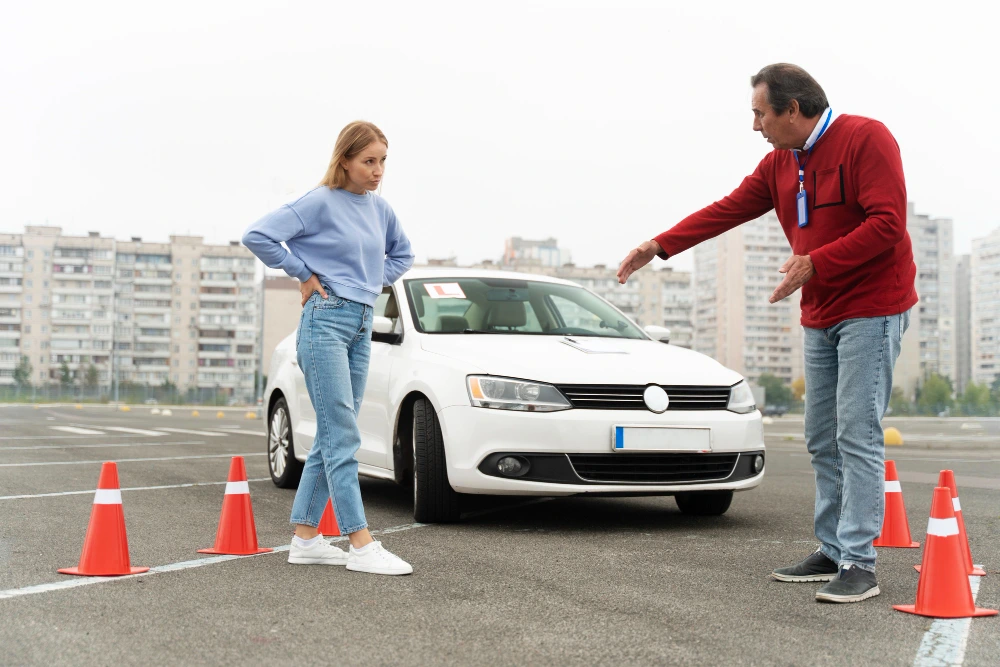
Finally, prior to your driving test, we conduct full mock drives from a stationary point all the way to your destination by following instructions without constant assurance from your instructor in order to evaluate your skills on a practical route. Using the same type of car as the one you will be taking for the test is also advised.
Ready to Practice the Right Way? Book Your Road Test Preparation Classes
The best route for learning is the one that tests you in a safe environment and helps you develop genuine skills, not memorize turns.
Ready to begin your training? Get in touch with Jim's Insync Driving School to schedule your classes and learn through our test-prepared routes.