

Driving skills are not limited simply to knowledge of traffic regulations. It incorporates a lot more, such as how to make the best use of one’s car in flowing traffic, the impact of timing on all actions, and the importance of control in reducing the element of chance and increasing safety. Such aspects are taught in car driving classesas integrated components so that students progress from nervous novices to confident individuals who understand what lies ahead on the road.
Below are six focused sections that explain how these skills are developed step by step.
Understanding Space Beyond the Vehicle
Space on the road is not limited to the size of your car. Drivers learn to see the safe areas that all vehicles move in, and the size of these areas changes as the car proceeds down the road, following the flow of traffic. Learners begin to understand:
- The appropriate distance between vehicles, which is necessary for leaving the car safely
- The difference in the following distance in dry weather and in the rain, or in a snowstorm, or in heavy traffic
- How the position of the car within a lane influences the ability of the driver to see and react
Such knowledge is important to avoid encroaching on other vehicles’ space and to avoid reactions during braking or nervousness.
How Timing Shapes Safe Driving Decisions
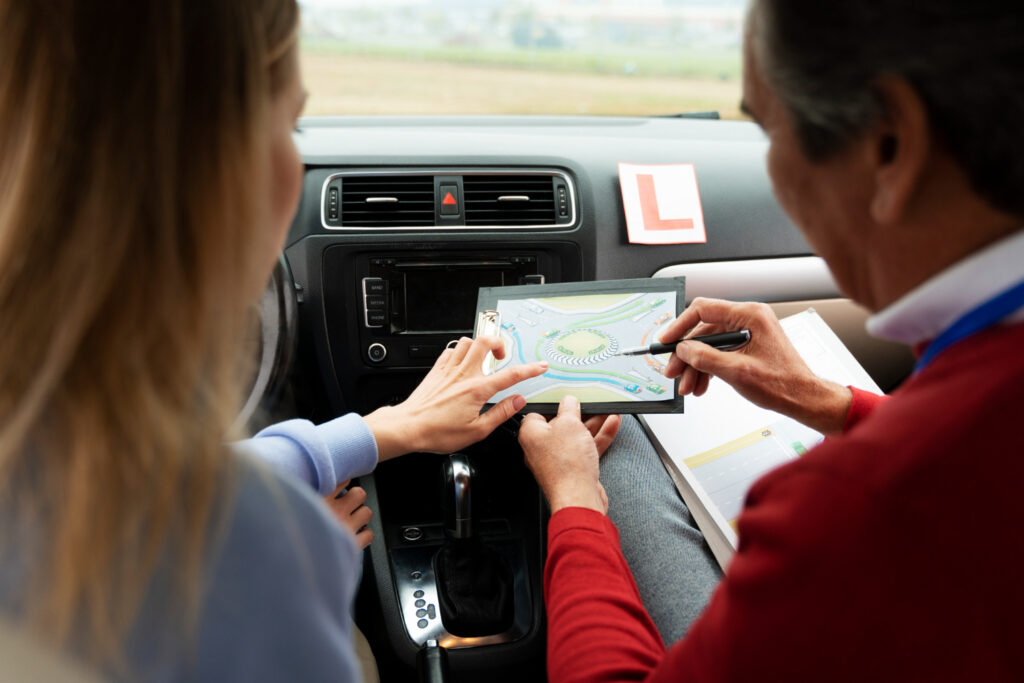
Timing is the difference between a well-executed turn and a risky one. It is the teacher’s role to help a trainee learn when to apply the brakes and when to “floor it.” In time, students get to:
- Estimate clearances while merging or turning
- Anticipate changes in the traffic-light signal
- Slow down a little to match the traffic stream rather than rush through
All the above teach patience and firmness, enabling drivers to navigate chaotic decision-making situations rather than rushing through whatever challenge they face.
Control Is Built Through Consistent Practice
Control of a vehicle is not about force; it is about precision. To control steering, acceleration, and braking smoothly, instruction is given while the student:
- Minus sharp steering inputs, attempts gentle corrections.
- Brake application must remain balanced to prevent the car from losing its balance.
- Acceleration should be smooth to keep it predictable for others.
Practice will make the control indefinite; they need to afford drivers the attention to the roads ahead.
Where Real Awareness Develops During Lessons
As learners gain confidence, in car drivers lessons introduce more complex environments such as busy intersections, traffic circles, and narrow streets. These situations reinforce how space, timing, and control work together. Drivers learn to scan continuously, adjust their position early, and prepare for others’ actions without overreacting.
This stage is where theoretical understanding turns into real-world skill.
Learning to Balance Confidence With Caution
Self-assurance grows when drivers comprehend their limits. Embers of lessons are encouraging to recognize and promptly add resilience when change occurs, thereby pausing to slow down, provide more safe space for positions to sort out, or withhold a traffic maneuver. This is a delicate balance; at the same time, it limits overconfidence and promotes gradual progress in driving.
Bringing It All Together for Real Roads
At the end of training, the students can integrate spatial awareness, time estimation, and vehicle control into a single process. When drivers complete anin-car driving course, they find it easier to use these skills without effort when driving around town or even on less populated roads.
At Jim’s Insync Driving School, the instructor will take students on in-person lessons to teach them skills focused on proper driving, rather than quick tricks.
It is possible to train with Jim’s Insync Driving School, which would do its best to help learners gracefully manage their road infrastructure rather than scaring them into performing better.